FREE DELIVERY ON UK ORDERS OVER £75 (EX VAT)

Teprenone in Skincare

Teprenone in Skincare: The Science Behind Renovage™ and Its Anti-Ageing Benefits
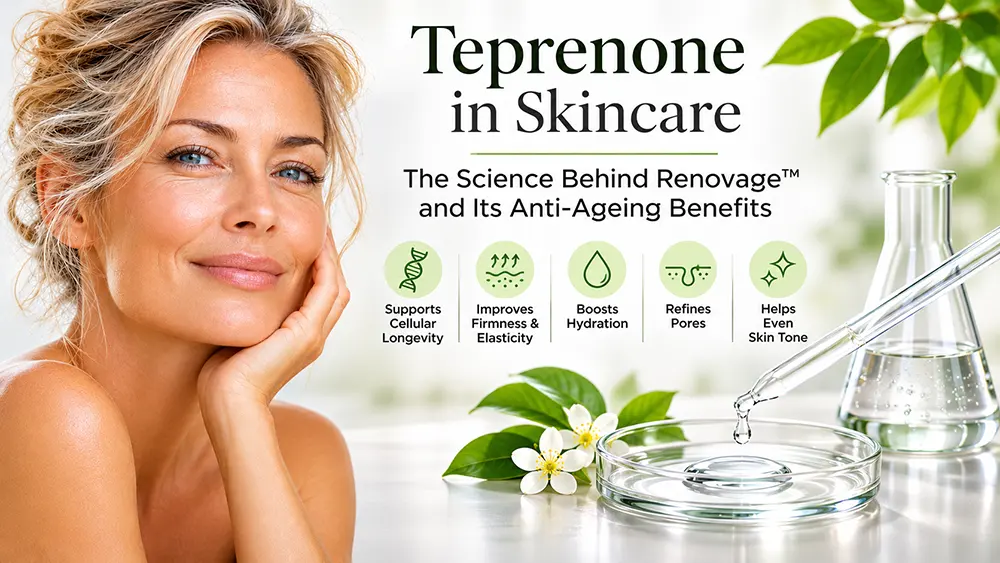
Discover how Teprenone, the active ingredient in Renovage™, is being used in advanced skincare formulations to address cellular ageing, improve skin hydration and support a firmer, smoother complexion.
Introduction: A Different Approach to Skin Ageing
The science of anti-ageing skincare has evolved considerably. While traditional ingredients such as moisturisers, antioxidants and exfoliating acids primarily address the visible consequences of ageing, newer cosmetic actives are being investigated for their effects on the biological processes associated with ageing skin.
One particularly interesting ingredient is Teprenone, also known as Geranylgeranylacetone (GGA).
Teprenone is the active component of Renovage™, a specialist cosmetic ingredient developed by Sederma. Its appeal lies in its potential to influence cellular stress responses and processes associated with skin ageing.
Research into Teprenone includes laboratory investigations of cellular longevity, oxidative stress, inflammation and skin-cell protection, alongside manufacturer-sponsored clinical testing of topical formulations.
For cosmetic formulators, this combination of research makes Renovage™ an interesting ingredient for sophisticated anti-ageing skincare.
What Is Teprenone?
Teprenone is a synthetic isoprenoid compound belonging to the broader family of terpenoid-related substances.
It has an established history of pharmaceutical use in Japan, where it has been used in the management of certain gastric conditions.
Researchers subsequently became interested in its ability to influence cellular stress responses, particularly through proteins involved in protecting cells against environmental and physiological stress.
This led to investigations into potential applications beyond its original pharmaceutical use, including skin protection and cosmetic anti-ageing formulations.
In cosmetic applications, Teprenone is commonly supplied in an oil-based carrier, such as Caprylic/Capric Triglyceride, under the trade name Renovage™.
Understanding Cellular Ageing
To appreciate why Teprenone is of interest, it helps to understand what happens to skin cells as they age.
Human skin contains several specialised cell types, including:
- Keratinocytes, which form the majority of the epidermis and contribute to the skin’s protective barrier.
- Fibroblasts, which are responsible for producing and maintaining components of the extracellular matrix, including collagen and elastin.
- Melanocytes, which produce melanin and contribute to skin pigmentation.
As skin ages, cellular function can become less efficient.
Fibroblasts may produce or maintain structural proteins less effectively, epidermal renewal can slow, and accumulated environmental damage can contribute to changes in pigmentation, hydration and texture.
An important process involved in ageing is cellular senescence.
What Is Cellular Senescence?
Cellular senescence describes a state in which cells stop dividing, often in response to accumulated damage, repeated replication or other stresses.
Although senescence is an important protective mechanism, the accumulation of senescent cells can contribute to age-related tissue changes.
Research published in Experimental Dermatology describes the complex relationship between skin ageing, cellular replication, oxidative stress and telomere biology.
These processes provide an important scientific background for understanding ingredients designed to support cellular resilience.
Teprenone and Cellular Longevity
One of the most frequently discussed characteristics of Renovage™ is its reported ability to extend the replicative lifespan of cultured skin cells.
In research described in Sederma’s patent documentation, normal human fibroblasts were cultured in the presence of different concentrations of Teprenone.
The researchers monitored the cells through repeated cycles of replication to investigate whether Teprenone influenced the onset of replicative senescence.
At a concentration of 3 micromolar, Teprenone-treated fibroblasts retained replicative activity for approximately 100 days longer than untreated control cells under the experimental conditions.
The study also reported differences in replicative capacity at individual stages of the experiment, including a 33% increase at one measured cycle.
What Does This Mean for Skincare?
These findings suggest that Teprenone can influence processes associated with cellular senescence under laboratory conditions.
However, it is important to distinguish between the extended replicative activity of cultured fibroblasts and the ageing of human skin.
An increase in cellular replicative lifespan does not mean that applying Renovage™ will extend the lifespan of skin cells by an equivalent percentage in living skin.
The findings are nevertheless scientifically interesting because fibroblast function is closely associated with the maintenance of skin structure.
Teprenone and Cellular Stress Protection
Every day, skin is exposed to environmental challenges, including ultraviolet radiation, pollution and oxidative stress.
These factors can influence cellular proteins, membranes and DNA, contributing to changes associated with premature skin ageing.
Teprenone has attracted scientific interest because of its effects on cellular stress-response pathways.
The Role of Heat Shock Proteins
Heat shock proteins are a family of proteins involved in maintaining normal cellular function during stressful conditions.
They help other proteins fold correctly, maintain their structure and respond to damage.
One extensively studied member of this family is heat shock protein 70, commonly abbreviated HSP70.
Experimental research has demonstrated that Teprenone can influence HSP70-related pathways, although its effects depend on the cell type, concentration and experimental conditions.
A study published in Molecular Pharmacology in 2007 investigated Teprenone’s effects on cellular protein-stress responses and found that it could also activate pathways associated with endoplasmic reticulum stress.
These findings illustrate that Teprenone’s biological activity is complex rather than being limited to a single protective mechanism.
For cosmetic scientists, understanding these pathways may help explain why Teprenone has been investigated as an ingredient associated with cellular resilience.
Teprenone, Oxidative Stress and Skin Inflammation
Oxidative stress occurs when the production of reactive oxygen species exceeds the capacity of the body’s protective systems to manage them.
Reactive oxygen species are naturally generated during cellular metabolism, but excessive levels can contribute to damage involving proteins, lipids and DNA.
Oxidative stress is also associated with inflammatory signalling and several processes involved in skin ageing.
A 2023 study published in Antioxidants, titled Geranylgeranylacetone Ameliorates Skin Inflammation by Regulating and Inducing Thioredoxin via the Thioredoxin Redox System, investigated Teprenone’s effects on pathways involved in oxidative stress and inflammation.
The researchers reported that Geranylgeranylacetone influenced the thioredoxin antioxidant system and signalling pathways involving Akt and Nrf2.
The study also reported reduced inflammatory cytokine production in its experimental models.
Why Is Thioredoxin Important?
Thioredoxin is a protein involved in maintaining cellular redox balance.
It participates in systems that help regulate oxidative stress and protect cellular components.
The researchers suggested that Teprenone’s influence on thioredoxin-related signalling could contribute to its observed effects on inflammatory responses.
These findings provide further insight into Teprenone’s potential biological activity.
However, experimental anti-inflammatory effects should not be interpreted as proof that a finished cosmetic product can treat inflammatory skin diseases.
Clinical Research: What Has Renovage™ Demonstrated?
While laboratory investigations help explain potential mechanisms, clinical testing is particularly relevant when assessing the cosmetic benefits of an ingredient.
Sederma’s patent documentation describes a single-blind study involving 24 women over the age of 45.
Participants applied an anti-ageing cream twice daily over a six-month period.
The researchers assessed changes in skin hydration, transepidermal water loss, visible pores, firmness, elasticity and other skin characteristics.
The following results were reported.
1. Improved Skin Hydration
Maintaining adequate hydration is essential for a healthy-looking complexion.
Well-hydrated skin generally appears smoother and more supple, while dehydration can make fine lines and surface irregularities more noticeable.
The clinical study reported:
| Treatment Period | Improvement in Hydration |
|---|---|
| 1 month | +34% |
| 3 months | +38% |
| 6 months | +30% |
These measurements were obtained using corneometry, an instrumental technique that assesses hydration in the outer layers of the skin.
The results suggest that the tested formulation was associated with sustained improvements in skin hydration.
2. Improved Skin Barrier Function
The skin barrier helps limit excessive moisture loss and protects against external environmental influences.
One method of assessing barrier function is to measure transepidermal water loss, or TEWL.
Lower TEWL generally indicates that less water is escaping through the skin.
The study reported:
| Treatment Period | Change in TEWL |
|---|---|
| 3 months | −11% |
| 6 months | −19% |
The reductions observed after three and six months suggest an improvement in moisture retention and skin barrier performance among responding participants.
For formulators developing moisturisers for mature or dry skin, this is a particularly relevant benefit.
3. Reduced Appearance of Enlarged Pores
Enlarged pores can become more noticeable as skin loses firmness and structural support.
Changes in skin texture and elasticity may also contribute to their appearance.
The clinical study reported:
| Treatment Period | Reduction in Dilated Pores |
|---|---|
| 1 month | −17% |
| 6 months | −26% |
These findings suggest that the tested formulation improved the visible appearance of dilated pores over time.
This makes Renovage™ potentially attractive for formulations intended to promote smoother, more refined-looking skin.
4. Improved Skin Firmness and Elasticity
Loss of firmness and elasticity is one of the most recognisable signs of skin ageing.
Changes in collagen, elastin and the extracellular matrix can gradually reduce the skin’s ability to maintain its structure.
In the Sederma study, instrumental measurements after one month indicated improvements in several mechanical properties of the skin.
| Parameter | Reported Improvement |
|---|---|
| Firmness | 12% |
| Elasticity | 11% |
| Skin tone (mechanical property) | 15% |
These findings are particularly relevant for firming creams, rejuvenating moisturisers and mature-skin formulations.
Importantly, the measurement of skin tone in this part of the study relates to a mechanical characteristic of the skin, rather than pigmentation or complexion colour.
5. Improved Appearance of Uneven Pigmentation
Age spots and uneven pigmentation are common concerns in mature skin.
The Sederma patent also reports measurements of ultraviolet-visible sunspots during the six-month clinical study.
| Treatment Period | Reduction in UV Sunspots |
|---|---|
| 1 month | −18% |
| 3 months | −39% |
| 6 months | −42% |
These findings suggest that the tested formulation may have helped improve the appearance of pigmentation-related irregularities.
However, these results should not be interpreted as evidence that Renovage™ provides sun protection or replaces sunscreen.
Understanding the Clinical Evidence
The reported results are encouraging, but several qualifications are important.
The study involved a relatively small group of participants, and the figures describe the performance of a tested formulation rather than isolated Teprenone applied directly to the skin.
The Renovage™ supplier literature specifies a 3% usage concentration for the marketed clinical claims. Formulators should consult the current supplier dossier to confirm the exact composition and concentration used in each study.
The patent documentation does not, by itself, establish that every observed improvement was attributable exclusively to Teprenone rather than other components of the finished formulation.
Independent, larger-scale clinical studies would provide additional confidence in the magnitude and reproducibility of these benefits.
Why Renovage™ Is Interesting for Cosmetic Formulators
Renovage™ is particularly attractive because its reported benefits extend beyond a single cosmetic concern.
Rather than focusing exclusively on moisturisation or surface exfoliation, it can be incorporated into formulations targeting several visible characteristics of ageing skin.
Potential applications include:
Mature Skin Moisturisers
Renovage™ can be incorporated into moisturisers designed to improve hydration, skin comfort and the appearance of firmness.
Firming Facial Serums
Oil-based or emulsified serums containing Renovage™ can be developed for consumers concerned about declining elasticity and skin texture.
Eye-Area Formulations
Its reported effects on hydration and skin firmness make Renovage™ an ingredient of interest for carefully formulated eye-area products, subject to appropriate safety assessment.
Overnight Rejuvenating Creams
Rich evening moisturisers can combine Renovage™ with complementary emollients and barrier-supporting ingredients.
Preventative Skincare
Although much of the clinical evidence concerns mature skin, formulators may also consider Renovage™ for products intended to maintain healthy-looking skin and address early visible signs of ageing.
Formulating with Renovage™
Renovage™ is supplied as an oil-soluble cosmetic ingredient, with Teprenone carried in Caprylic/Capric Triglyceride.
This makes it suitable for incorporation into the oil phase of emulsions or into anhydrous formulations.
Recommended Usage
| Property | Details |
|---|---|
| Trade name | Renovage™ |
| Active ingredient | Teprenone |
| INCI | Caprylic/Capric Triglyceride, Teprenone |
| Recommended usage | 1–3% |
| Supplier clinical usage level | 3% |
| Solubility | Oil-soluble |
| Recommended addition | Cool-down phase, at or below 40°C |
For emulsions, Renovage™ is generally incorporated during cool-down to minimise unnecessary thermal exposure.
For anhydrous products, it can be blended with compatible oils and emollients.
As with any active ingredient, formulators should assess compatibility, stability and the safety of the finished formulation.
Renovage™ is a cosmetic raw material and should not be applied undiluted directly to the skin.
Can Renovage™ Be Combined with Other Anti-Ageing Ingredients?
Renovage™ may be used alongside other cosmetic actives to create multifunctional skincare formulations.
For example:
Hyaluronic Acid
Provides hydration and contributes to a plumper, smoother skin appearance.
Niacinamide
Supports the skin barrier and helps improve the appearance of uneven skin tone.
Peptides
Can be incorporated into formulations designed to improve the visible appearance of ageing skin, depending on the peptide selected.
Ceramides and Barrier Lipids
Complement moisturising formulations by supporting the skin’s protective lipid structure.
Antioxidants
May be included to help protect the formulation or support cosmetic strategies addressing environmental stress, depending on their demonstrated properties.
These combinations offer interesting formulation possibilities, although compatibility and additive efficacy should not be assumed without testing.
Conclusion: A Promising Multifunctional Anti-Ageing Active
Teprenone represents an interesting development in cosmetic ingredient science.
Its research background includes investigations into cellular senescence, stress-response proteins, oxidative stress and inflammatory signalling.
Meanwhile, clinical testing reported by Sederma provides evidence of improvements in several visible skin characteristics, including hydration, barrier performance, firmness, elasticity and pore appearance.
Although further independent clinical research would help establish the full extent of its benefits, Renovage™ offers cosmetic formulators a versatile ingredient for developing sophisticated anti-ageing products.
For those creating formulations intended to improve the appearance of mature or ageing skin, Renovage™ is a noteworthy addition to the cosmetic formulator’s ingredient toolkit.
Scientific References and Further Reading
1. Sederma – Topical Use of Teprenone
US Patent Application US20090214607A1.
Describes experimental investigations into Teprenone’s effects on cellular senescence, stress responses and skin characteristics, together with clinical testing of topical formulations.
2. Buckingham, E. M. & Klingelhutz, A. J. (2011)
The Role of Telomeres in the Ageing of Human Skin.
Experimental Dermatology, 20(4), 297–302.
Explores telomere biology, cellular senescence and the relationship between cellular ageing and skin function.
3. Jacczak, B., Rubiś, B. & Totoń, E. (2021)
Potential of Naturally Derived Compounds in Telomerase and Telomere Modulation in Skin Senescence and Aging.
International Journal of Molecular Sciences, 22(12), 6381.
A review examining telomeres, telomerase and their relevance to skin ageing. This provides background science rather than direct clinical evidence for Teprenone.
4. Geranylgeranylacetone Ameliorates Skin Inflammation by Regulating and Inducing Thioredoxin via the Thioredoxin Redox System (2023)
Antioxidants.
Investigates the effects of Geranylgeranylacetone on thioredoxin-related pathways, oxidative stress and inflammatory responses.
5. Endo, S. et al. (2007)
Geranylgeranylacetone, an Inducer of the 70-kDa Heat Shock Protein (HSP70), Elicits Unfolded Protein Response and Coordinates Cellular Fate Independently of HSP70.
Molecular Pharmacology, 72(5), 1337–1348.
Examines the complex effects of Geranylgeranylacetone on cellular stress-response pathways.
Disclaimer: This article is provided for educational and cosmetic formulation purposes. Laboratory findings do not necessarily translate into equivalent clinical outcomes, and supplier-sponsored results may not be independently verified. Renovage™ is intended for incorporation into cosmetic formulations and is not presented as a treatment for medical conditions.