FREE DELIVERY ON UK ORDERS OVER £75 (EX VAT)
Betaine in Skincare

Betaine in Skincare: Benefits, Uses and Formulation Guide
Betaine is one of those remarkably versatile cosmetic ingredients that often receives less attention than better-known humectants such as Glycerin and Hyaluronic Acid. Yet this naturally derived ingredient offers an impressive combination of moisturising, skin-conditioning and formulation benefits.
Commonly obtained from sugar beet, Betaine helps maintain the skin’s moisture balance, improves the sensory properties of cosmetic formulations and can reduce the irritation potential of certain cleansing products.
Whether you’re developing a lightweight facial serum, a moisturising cream or a gentle shampoo, Betaine is an ingredient well worth considering.
In this guide, we’ll explore what Betaine is, how it works, its benefits for skin and hair, and how to incorporate it into your own formulations.
What Is Betaine?
Betaine, also known as Trimethylglycine (TMG), is a naturally occurring compound found in plants and other living organisms. Commercial cosmetic-grade Betaine is frequently produced from sugar beet, although the precise origin depends on the manufacturer.
Chemically, Betaine is a zwitterionic compound, meaning it contains both positive and negative charges within the same molecule while remaining electrically neutral overall.
This unusual structure contributes to its ability to interact with water and other molecules, making it particularly useful as a humectant and osmolyte.
An osmolyte is a substance that helps cells maintain their internal water balance when exposed to changes in their surrounding environment.
In cosmetic formulations, Betaine provides moisturising and conditioning benefits without the heavy or sticky feel sometimes associated with high concentrations of other humectants.
Five Benefits of Betaine in Skincare
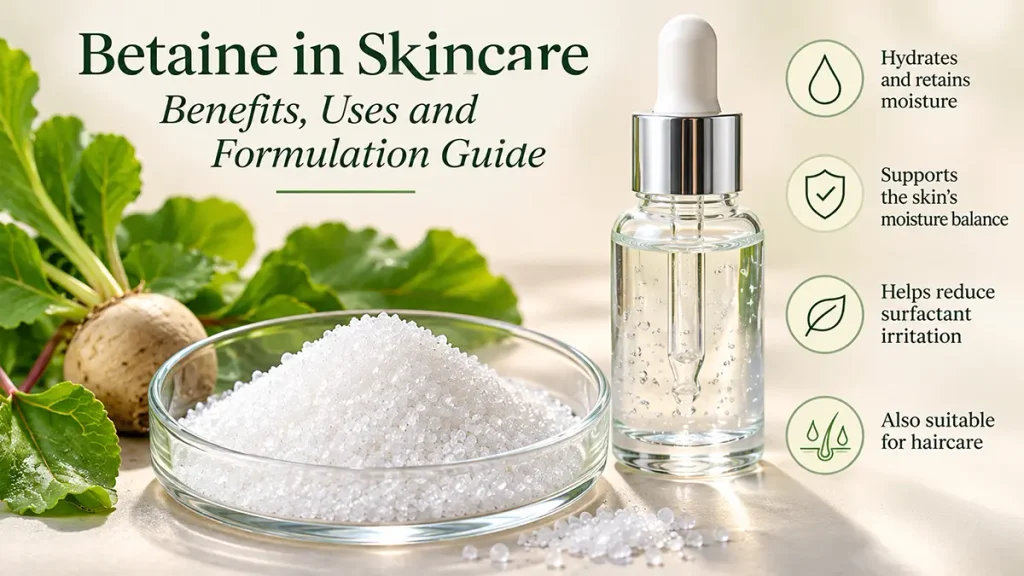
1. Helps Maintain Skin Hydration
Betaine is a water-soluble humectant that helps attract and retain moisture.
It supports skin hydration and can improve the feel of dry or dehydrated skin, making it particularly suitable for moisturising serums, lotions and creams.
Unlike ingredients that primarily form an occlusive barrier on the skin’s surface, Betaine contributes to hydration through its interaction with water.
2. Supports the Skin’s Moisture Balance
As an osmolyte, Betaine helps maintain water balance in biological systems.
This property makes it interesting for formulations designed to support skin comfort under drying environmental conditions.
Betaine can complement other moisturising ingredients, including Glycerin, Panthenol and Hyaluronic Acid, in products intended to improve skin softness and suppleness.
3. Can Reduce the Irritation Potential of Cleansers
One of Betaine’s particularly useful properties is its ability to moderate the irritation potential of certain surfactant systems.
In cleansing formulations, Betaine may help reduce the harshness associated with some surfactants, contributing to a gentler skin feel.
This makes it useful in facial cleansers, body washes, hand washes and shampoos.
However, the extent of this effect depends on the surfactant system, Betaine concentration and overall formulation.
4. Improves Skin Feel
Betaine can contribute to a smooth, comfortable after-feel in skincare products.
It is particularly useful in lightweight serums and lotions where formulators want effective hydration without excessive tackiness.
Its compatibility with many common cosmetic ingredients makes it straightforward to incorporate into a wide range of products.
5. Provides Hair-Conditioning Benefits
Betaine isn’t limited to skincare.
In shampoos, conditioners and hair treatments, it can contribute to moisture retention and improved hair feel.
It is particularly useful in formulations intended for dry hair or products where mildness and conditioning are priorities.
Betaine vs Glycerin: Which Is Better?
Glycerin is one of the most widely used humectants in cosmetic formulation. It is inexpensive, effective and compatible with an enormous variety of ingredients.
Betaine offers a complementary approach to moisturisation.
| Property | Betaine | Glycerin |
|---|---|---|
| Primary function | Humectant and osmolyte | Humectant |
| Water solubility | Excellent | Excellent |
| Skin feel | Generally smooth, low tack | Can become sticky at higher levels |
| Surfactant mildness | May help reduce irritation potential | Primarily contributes moisturisation |
| Typical cosmetic usage | 1–5% | 1–10%, sometimes higher |
| Suitable for skincare | Yes | Yes |
| Suitable for haircare | Yes | Yes |
Rather than treating Betaine and Glycerin as competing ingredients, formulators can use them together.
For example, a hydrating serum might contain 2% Betaine and 2% Glycerin, combining their moisturising properties while maintaining a pleasant skin feel.
The ideal balance should be established through formulation testing.
Is Betaine the Same as Cocamidopropyl Betaine?
No. Despite their similar names, these are two different cosmetic ingredients.
Betaine (Trimethylglycine) is primarily used as a humectant, osmolyte and skin-conditioning ingredient.
Cocamidopropyl Betaine (CAPB) is an amphoteric surfactant commonly used in shampoos, body washes and facial cleansers to provide cleansing, foam boosting and improved surfactant mildness.
Betaine does not function as a conventional cleansing surfactant and cannot replace Cocamidopropyl Betaine on a like-for-like basis.
This distinction is particularly important when selecting ingredients for cosmetic formulations.
How Much Betaine Should You Use?
Betaine is relatively straightforward to formulate with, making it suitable for both beginners and experienced cosmetic formulators.
A commonly suggested usage range is 1–5%, although the appropriate concentration depends on the product and the manufacturer’s recommendations.
| Application | Illustrative usage level |
|---|---|
| Facial serums | 1–3% |
| Moisturising creams | 1–5% |
| Facial cleansers | 1–3% |
| Shampoos | 1–5% |
| Hair conditioners | 1–3% |
| Body lotions | 1–5% |
These are starting ranges for formulation development rather than guaranteed optimum concentrations.
Incorporating Betaine into a Formulation
Betaine is readily soluble in water and can generally be added directly to the aqueous phase.
For best results:
- Weigh the required quantity of Betaine accurately.
- Add it to the water phase with gentle stirring.
- Mix until completely dissolved.
- Incorporate the remaining ingredients according to the formulation procedure.
- Check and adjust the finished product’s pH as required.
- Confirm preservation, stability and compatibility through appropriate testing.
Betaine is compatible with many commonly used cosmetic ingredients and can be incorporated into both cold-process and heated formulations, subject to the supplier’s technical guidance.
Example Formulation: Betaine & Hyaluronic Acid Hydrating Serum
This simple, lightweight serum demonstrates how Betaine can be combined with other humectants to produce a moisturising facial treatment.
Formula — 100 g Batch
| Ingredient | % |
|---|---|
| Distilled Water | 91.2 |
| Betaine | 3.0 |
| Glycerin | 2.0 |
| Panthenol (75% Solution) | 2.0 |
| Sodium Hyaluronate (1.3 MDa) | 0.2 |
| Hydroxyethylcellulose | 0.3 |
| Broad-spectrum Preservative* | 1.0 |
| Sodium Phytate | 0.1 |
| pH Adjuster* | 0.2 |
| Total | 100.0 |
The preservative is an illustrative placeholder and must be selected according to its supplier’s recommended concentration, permitted applications and effective pH range. The pH adjuster is a provisional allowance; its actual quantity must be determined experimentally, with water adjusted to maintain 100%.
Method
Phase A — Hydration
- Add the distilled water to a clean, sanitised mixing vessel, reserving a small portion for any necessary pH adjustment.
- Premix the Hydroxyethylcellulose with the Glycerin to help prevent clumping.
- Add the premix to the water with stirring and allow the thickener to hydrate fully.
- Sprinkle the Sodium Hyaluronate gradually into the mixture and allow it to hydrate completely.
Phase B — Water-Soluble Actives
- Add the Betaine and mix until dissolved.
- Add the Panthenol solution and Sodium Phytate, stirring until homogeneous.
Phase C — Finishing
- Incorporate the selected preservative according to its manufacturer’s instructions.
- Measure and adjust the pH, targeting approximately 5.0–5.5 where compatible with the selected preservative and other ingredients.
- Adjust the final batch weight with distilled water, mix thoroughly and transfer into suitable packaging.
The resulting serum is intended to provide lightweight hydration with a smooth, comfortable skin feel.
Important: This is an illustrative development formula, not a validated finished product. The preservative system, viscosity, stability, packaging compatibility and microbiological safety must be verified before sale or consumer use.
Can Betaine Be Used in Natural Skincare?
Betaine is particularly attractive to formulators developing naturally positioned skincare products.
Cosmetic-grade Betaine is frequently derived from sugar beet, a renewable agricultural raw material.
However, natural-origin claims should be supported by the specific manufacturer’s documentation.
Where relevant, formulators should request information on the manufacturing process, natural-origin index and any applicable COSMOS or other certification.
A plant-derived ingredient is not automatically certified organic or approved under a particular natural cosmetics standard.
Does Betaine Replace a Preservative?
No.
Although Betaine interacts with water and can influence formulation properties, it should not be considered a preservative at normal cosmetic usage levels.
Water-containing products incorporating Betaine generally require an appropriate preservation strategy.
The effectiveness of the selected preservative should be assessed through suitable microbiological testing, including preservative efficacy testing where appropriate.
Frequently Asked Questions
Is Betaine suitable for sensitive skin?
Betaine is commonly used in products designed for mildness and skin comfort. It can help moderate the irritation potential of some surfactant systems, although the suitability of a finished product depends on its complete formulation.
Is Betaine a natural ingredient?
Betaine occurs naturally in plants and is frequently manufactured from sugar beet. The natural-origin status of a commercial grade depends on its source and processing method.
Can Betaine be used with Hyaluronic Acid?
Yes. Betaine and Hyaluronic Acid can be combined in moisturising formulations to provide complementary hydration benefits.
Can Betaine be used with Niacinamide?
Yes. Betaine and Niacinamide are generally compatible in appropriately formulated water-based skincare products.
Is Betaine suitable for haircare?
Yes. Betaine is used in shampoos, conditioners and other haircare products to support moisture retention, conditioning and formulation mildness.
Is Betaine suitable for cold-process formulations?
Yes. Its excellent water solubility makes it convenient for many cold-process formulations, provided the other ingredients and processing conditions are compatible.
Final Thoughts
Betaine may not be as widely recognised as Hyaluronic Acid or Glycerin, but it is an exceptionally useful ingredient for modern cosmetic formulation.
Its combination of moisturising, osmoprotective and skin-conditioning properties makes it valuable in everything from lightweight facial serums to gentle cleansers and haircare products.
For formulators seeking an effective, versatile and potentially plant-derived humectant, Betaine deserves a place in the formulation toolkit.
Looking to incorporate Betaine into your next formulation?
Explore our Betaine cosmetic ingredient at The Formulary, together with complementary humectants including Hyaluronic Acid, Glycerin and Panthenol.